Swan, Materialism,Idealism
王陽明的心學和哲學是否其實適用於這世界萬物呢,包括動物、沒有生命的物體(包括磚頭),我想是的,而“心”這一概念其實適用於萬物間所有事。
The philosophy of Wang Yangming, particularly his concept of “xin” (心), which can be translated as “mind” or “heart,” posits that this intrinsic quality is applicable to all things in the world, animate and inanimate alike. According to Wang Yangming, everything in the universe is a manifestation of the “xin,” suggesting that even objects without life, such as bricks, are embodiments of the collective human “xin.” This perspective aligns with his teachings that the external world is a reflection of one’s internal state.
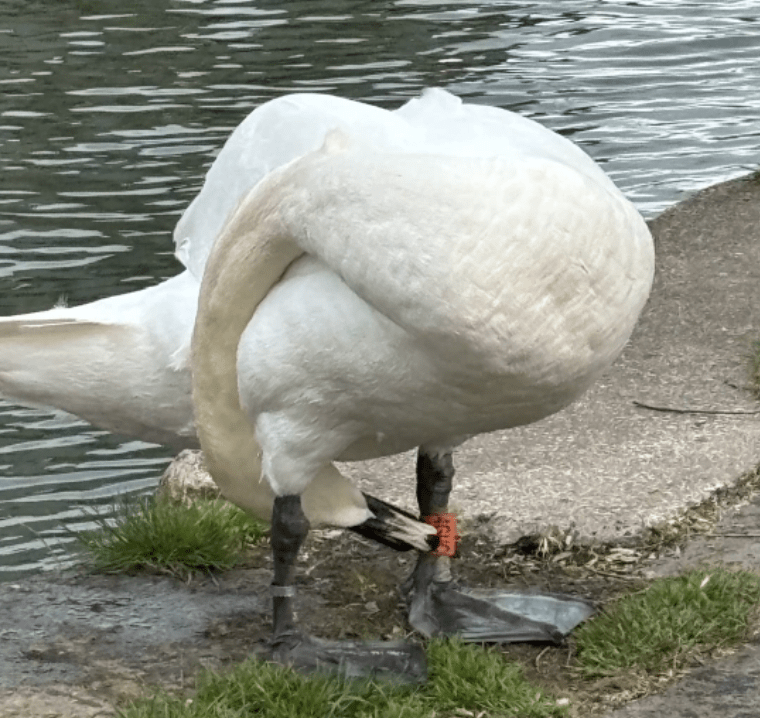
傍晚在康河旁散步,有緣偶遇一隻天鵝。它花了整整十分鐘就為了拜託人類給他左腳上系的動物編號和標籤。這隻天鵝可能擁有他的心“不希望被束縛”,所以發動了他的意“希望取下這個標籤”,也因此有了行 – 不斷啃掉這個標籤。這樣從心意行一體的行為,和這一隻鵝的掙扎,與人類本質又有何區別呢?每一個人都被一個什麼束縛著,而都想掙脫,而從束縛者的角度來說,這或許也是為了保護它,或許也有控制的私慾。
One evening by the Cam River, I encountered a swan that spent ten minutes trying to solicit human help to remove a tag tied to its left foot. This behavior suggests the swan has its own “xin,” desiring freedom from its physical constraints and actively attempting to remove the tag. This integration of intention (“yi”) and action reflects a universal struggle against constraints that parallels human desires for freedom, though such constraints may also serve protective or controlling purposes.
這一思考讓我迅速回到了在北京大學上楊立華教授的課堂,他對陽明哲學的解讀從心這一概念展開。他說,這世間萬物其實都是心的體現。這大橋,這燈,這建築,看似沒有生命 也沒有心,但是其實他們都來自人類的心。正式幾百萬年前人類祖先的心知道在打獵的時候,應該往左邊走,還是右邊走這樣的本心,才一步步逐漸在發展過程中創造了你周圍環境的所有物體。而這一個個物體之間都是人類的心的體現。陽明的“心”從來不是指代一個個人的“心”。
This reflection brought me back to a classroom at Peking University with Professor Yang Lihua, where he expanded on Yangming’s philosophy starting from the concept of “xin.” He explained that all entities, such as bridges, lamps, and buildings—though seemingly lifeless—are actually derived from human “xin.” This idea extends to the instinctual decisions our ancestors made, such as which direction to hunt, shaping the creation and development of our surroundings. These objects are not just material but are imbued with human “xin.”
先生曰:“你未看此花时,此花与汝心同归于寂;你来看此花时,则此花颜色一时明白起来。便知此花不在你的心外。” 說的正是這個道理。
Yangming famously said, “When you do not see this flower, it and your heart are both in stillness; when you do see this flower, its colors become clear all at once. Then you know this flower is not outside your heart.” This illustrates that there is no true separation between one’s consciousness and the external world.
本質上,或許唯物主義與唯心主義之間的區別沒有那麼大,反而他們可能是為一體。人類苦苦追求大一統物理理論,追求那個基本定理,也許就像幾百萬年前人類祖先知道在打獵的時候應該往左邊走還是右邊走這樣的本心,才從零開始創造了整個宇宙,而這樣周圍的任何事物的誕生,本質上都是發於心。
Fundamentally, the distinction between materialism and idealism might not be as significant as presumed, perhaps suggesting their unity. Humanity’s pursuit of a unified physical theory, akin to the ancestral knowledge of which direction to hunt, suggests that all aspects of the universe originate from “xin.”
“可知充天塞地中间,只有这个灵明。人只为形体自间隔了。我的灵明,便是天地、鬼神的主宰。天没有我的灵明,谁去仰他高?地没有我的灵明,谁去俯他深?鬼神没有我的灵明,谁去辨他吉、凶、灾、祥?天地、鬼神、万物,离却我的灵明,便没有天地、鬼神、万物了;我的灵明,离却天地、鬼神、万物,亦没有我的灵明。如此,便是一气流通的,如何与他间隔得?”
又问:“天地、鬼神、万物,千古见在,何没了我的灵明,便俱无了?”
曰:“今看死的人,他这些精灵游散了,他的天地、鬼神、万物尚在何处?”
Yangming further posits, “Between heaven and earth, there is only this clear awareness. It is only separated by physical forms. My clear awareness is the master of heaven, earth, and the spirits. Without my awareness, who would look up to the heavens or down upon the earth? Without my awareness, how would one discern the auspiciousness or calamities brought by spirits? Without my clear awareness, there would be no heaven, earth, or spirits; without them, there would also be no clear awareness. Thus, there is a continuous flow, how can there be separation?” He questions, “If all things have been seen since ancient times, why without my clear awareness, would all cease to exist?” This implies that upon death, when one’s spirit disperses, where do their heaven, earth, and all things remain?

 Yuxin Hu
留下评论