This blog was intended for fun only and does not imply any of my political or social view. Please don’t over critisize or take it over-seriously.
Written in Pembroke College, Cambridge on Apr 10, 2024.
Any discussions send to: yh552@cam.ac.uk
It may has come to many Asian (or those who stand as the British elites) people’s suprise that the British has just passed relevant updated laws on its flexible work system. As quoted from The Chartered Institute of Personnel and Development 2024, the updated regulations say:
Under the new regulations, employees will be entitled to request flexible working arrangements from the very first day of their employment rather than after 26 weeks as is currently. This includes requests for part-time, term-time, flexitime, compressed hours, and varied working locations.
Employers need to be aware that, under the new rules, before they reject any request for flexible working arrangements, they have to explain the reasons behind their decision. Previously, employers could deny any request for flexible working without explanation.
Employers are also now obliged to respond to flexible working requests within two months, compared to three months previously.
Under the new legislation, employees can also make two statutory requests for flexible working in any 12-month period, as opposed to one request previously.
Although this system had already begun to sprout several years ago and was propelled in a new direction by the 2019 coronavirus pandemic, it has also given countless of work for the labour economists and organization managment researchers. This blog does not discuss any economic or managerial implications of the system (I might try those when doing my PhD), but rather tries to link between the development of the rising hedonism and individualism in the UK and other developed countries and the horible World War III.
Replacement of jobs by robots?
The complete replacement of human labor by automation and artificial intelligence in the production processes is almost inevitable in the history of humanity in this century.
Flexible working systems and high benefits (if there are no restrictions on working hours and working locations) will inevitably lead to the gradual loss of learning ability and productivity of most ordinary workers who are addicted to the enjoyment of this system. The Self-Determination Theory (SDT) articulates that human motivation is sustained by fulfilling three intrinsic needs: autonomy, competence, and relatedness. Flexible work arrangements and high welfare can, ostensibly, satisfy these needs by offering freedom (autonomy), support (relatedness), and the opportunity for skill development (competence). However, without structured guidance and incentives that align with these psychological needs, the intrinsic motivation to engage in and improve upon work-related tasks may wane. The ability to work anytime and anywhere can lead to decision fatigue, procrastination, and a decrease in overall productivity. The abundance of choice, rather than liberating individuals, can create a paralysis that hinders the ability to initiate and complete tasks effectively.
Also, when individuals exert less effort to achieve a task when they work in a group than when they work alone. The diminished visibility of individual contributions can exacerbate this phenomenon, leading to lower overall productivity. The sense of anonymity and lack of immediate accountability in remote or flexible working conditions can dilute the individual’s perception of their essential role within a team, further diminishing motivation and output.
However, human societies will continue to necessitate a substantial volume of work characterized by fixed hours and locations to ensure the smooth functioning of societal mechanisms. This structure allows for the synchronization of activities across different sectors, facilitating supply chain logistics, manufacturing, public services, and more. The predictability of work schedules ensures that businesses can plan, coordinate, and execute operations efficiently, which is crucial for the maintenance of critical infrastructure. Without fixed schedules, the coordination required for complex projects and essential services, such as power generation and distribution, public transportation, and healthcare services, would be jeopardized, potentially leading to systemic failures and economic disruption.
Someone asked Hinton what he considered the most exciting opportunity presented by AI. “That it will kill us all,” he joked
So how will such gap be filled in? The answer is clear: automation and artificial intelligence.
Geoffrey Hinton spent half a century developing artificial intelligence. Now, he worries that his life’s work could spell the end of humanity. Inside his mission to warn the world. there is no greater authority on AI. A Brit by birth and a Canadian by choice, he has been directly—or, through the work of his students and colleagues, indirectly—involved in nearly every major deep-learning breakthrough, including the development of generative AI tools like DALL-E. When he spoke up, the world listened. It wouldn’t take long—maybe five to 20 years, he thought—for AI to become smarter than humans altogether.
Regarding automation technologies, Chinese companies, offering tech from conveyor belts and motors to advanced manufacturing robots, are also expanding rapidly in their home country, which is the world’s largest market for the sector. More than half of all industrial robot installations in the world took place in China in 2022, according to figures from the International Federation of Robotics.
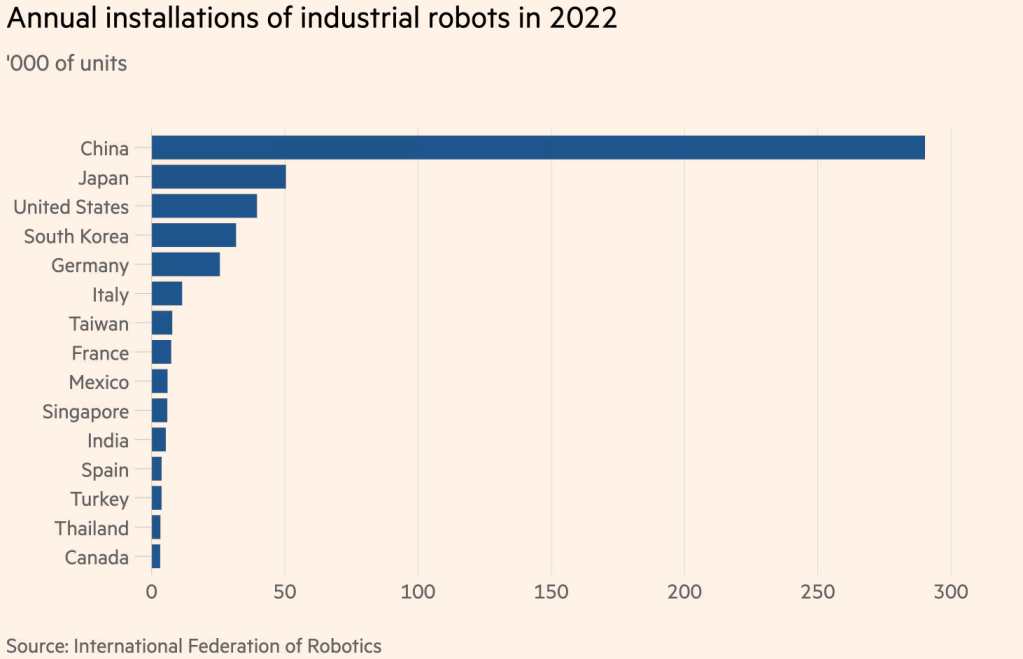
According to the International Federation of Robotics, the global robotics industry hit an all-time high with over half a million new industrial robots installed in 2021, signaling a robust growth trajectory. The report highlights significant growth in robot installations across major markets such as Japan, Korea, Europe, and the Americas. Japan, for example, saw a 22% increase in installations in 2021, reflecting a strong rebound across industries. Europe experienced a 24% increase in installations, driven by demand in both the automotive sector and general industry. The Americas saw a 31% increase in installations, showcasing a remarkable recovery post-pandemic. This uptrend is expected to continue, with global robot installations forecasted to grow by 10% to almost 570,000 units in 2022, and average annual growth rates in the medium to upper single-digit range are forecasted from 2022 to 2025 (IFR International Federation of Robotics).
TechHQ provides a historical overview and future outlook of autonomous robots, noting that the market for industrial robots has significantly evolved over the past 50 years. The term “cobots” or collaborative robots has emerged to describe robots that work alongside humans. With an estimated three million or more autonomous robots currently in use, their impact across industries is undeniable. The evolution of robots from basic autonomous devices to complex systems capable of intricate tasks underscores the rapid pace of technological advancements in this field (TechHQ).
These automation robots, nurtured by the greediness of power and capital, can only be cheaper, more efficient, more intelligent, and most importantly, more prevalent in the global manufacturing industries.
The Widening Income Gap
Despite nations becoming richer, governmental wealth has not kept pace when considering the net wealth of the private and public sectors. Wealth inequalities have surged, especially at the top, with the global multimillionaires capturing a disproportionate share of global wealth growth since the mid-1990s. According to the World Inequality Report: The poorest 50% of the population own just 2% of total net wealth, an average of PPP $4,100 per adult in 2021. The middle 40% of people own 22% of total net wealth, an average of PPP $57,300 per adult in 2021. However, this might yet be the best time already in this century.
Over a recent research from the Bank for International Sttlements in 2023, it has been found higher AI investment is associated with higher income and a higher income share for the top decile, while the income share declines for the bottom decile. Investment in AI in the real estate, network technology and robotics sectors has an especially pronounced link with inequality. Furthermore, AI investment is associated with broader economic shifts, including increased total factor productivity (TFP) and modern service exports. There is also a shift from mid-skill jobs to high-skill and managerial positions, accompanied by a decline in the labour share of income. Overall, these findings are consistent with structural transformation and skill-biased technical change, as seen over the last decade, leading to widening income inequality.
How such disparity may arise through international trade? Advanced economies have higher wages because total factor productivity is higher. These higher wages induce firms in advanced economies to use robots more intensively to begin with, especially when robots easily substitute for workers. Then, when robot productivity rises, the advanced economy will benefit more in the long run. This divergence grows larger, the more robots substitute for workers. The landscape is likely going to be much more challenging for developing countries which have hoped for high dividends from a much-anticipated demographic transition. Furthermore, the increase in productivity of robots fuels strong demand to invest in robots and traditional capital (which is assumed to be complementary to robots and labor). This demand is larger in advanced economies due to robots being used more intensively there (the “share-in-production” channel discussed above). As a result, investment gets diverted from developing countries to finance this capital and robot accumulation in advanced economies, thus resulting in a transitional decline in GDP in the developing country.
Also, a developing economy will likely specialize in sectors that rely more on unskilled labor, which it has more of compared to an advanced economy. Assuming robots replace unskilled labor but complement skilled workers, a permanent decline in the terms of trade in the developing region may emerge after the robot revolution. This is because robots will disproportionately displace unskilled workers, reducing their relative wages and lowering the price of the good that uses unskilled labor more intensively. The drop in relative price of its main output, in turn, acts as a further negative shock, reducing the incentive to invest and potentially leading to a fall not just in relative but in absolute GDP.
So within a capitalism system, what will happen within a country? At the heart of the capitalist system is the ownership of capital—assets that generate income. In a scenario where artificial intelligence (AI) and automation technologies are primarily owned by a small group of capitalists, these individuals or entities stand to gain disproportionately from the productivity and efficiency improvements these technologies offer. The fundamental principle of capitalism is that capital tends to accumulate, leading to the concentration of wealth in the hands of those who already have it. As AI and automation can be seen as forms of capital, their benefits—increased productivity, reduced costs, and potentially huge profits—are likely to flow to their owners, thereby exacerbating wealth inequality. The consolidation of wealth and economic power in the hands of a few can also lead to a socio-political dynamic where these individuals or groups have disproportionate influence over public policy, labor laws, and the direction of technological development. This influence can be used to sustain or even increase their advantage, potentially leading to a feedback loop that further entrenches wealth disparities. From a broader socio-economic perspective, the concentration of wealth resulting from AI and automation controlled by capitalists can lead to reduced consumer spending power among the general population. Wealth inequality tends to lead to lower levels of economic activity since the wealthy spend a smaller proportion of their income than lower-income individuals. This reduction in spending can exacerbate economic cycles, leading to periods of recession or stagnation that disproportionately affect the less wealthy.
The Rise of Global Populism, Nationalism and Conflicts of Institutional Values
We heard there was a secret chord that David played, and it pleased the Lord.
But you don’t really care for music, do you?
The truth is, you were moving to the fourth, the fifth,
The minor fall, the major lift,
With every breath you drew was Hallelujah.
Hallelujah,
Hallelujah,
Hallelujah,
Hallelujah,
Hallelujah.
But behind the praise was hatred, was love that faded away.
In the early days of December 2023, the United Kingdom, once the dominant global power of the 19th century and a core nation in spearheading the previous wave of globalization, announced a tightening of its immigration policies. The Conservative government of the UK, in an effort to curb the influx of foreign workers, including those from Hong Kong holding special visas, raised the minimum salary required to obtain a UK work visa to £38,700—a 47% increase from the original base salary. The UK has historically faced a shortage of healthcare professionals, relying on medical staff from abroad to fill these gaps. Recently, nursing staff have taken to the streets multiple times to protest, citing the nearly four-year battle with COVID-19 and long working hours, underscoring the need for more immigrant support. However, the new regulations by the UK government restrict international medical immigrants from bringing their families to the UK. Care England has emphasized that past immigration has been a lifeline for the British health sector, and the new measures could push an already fragile medical system to the brink. Yet, the prevailing mindset against foreign influence seems to preclude rational discussion on these public issues.
The most radical anti-immigration rhetoric globally comes from Donald Trump.
“I swear to you, we will eradicate the communists, Marxists, fascists, and radical left-wing mobs. These people, living in our country, thrive on lying, stealing, and cheating,”
declared Trump, potentially in the running for the 2024 US presidency, during the Veterans Day speech in 2023. He equated illegal immigrants from Latin America to a sum of fascists, communists, and mobs—an act of ignorant hate and dangerous incitement. Lumping fascists and communists together, as absurd as pairing beef soup with aiyu jelly, yet Trump’s hateful rhetoric was met with applause. From Brexit to Trump’s resurgence, the driving forces in society transform their decline into external hatred.
“You don’t know how wonderful Britain was in those days. To touch the green grass of home was truly wonderful! The hometown and the old house still stand as they were, albeit with peeling paint. And there, the old oak tree where I used to play as a child. Walking down the alley with my beloved Mary, her golden hair flowing, lips like cherries, to touch the green grass of home was truly wonderful!”
In reminiscing about an irrecoverable past, those lost souls have embraced a similarly recurring theme in human history: exclusionary nationalism, which, although echoing the calls of homeland and ethnicity, is filled with venomous rage.
Why has the United States become one of the most famous countries for its internal division, verging on “civil war,” and societal polarization? Donald Trump is not the sole reason. He merely represents the forces of hatred and anger, stemming from helplessness and despair.
What is less noticed is that these hotbeds of far-right activity are the colonial powers of the 18th, 19th, and 20th centuries. Through colonial exploitation, their citizens, especially the nobility, enjoyed abundant resources and a refined civilization. However, the end of World War II marked the collapse of their “pirate-style international colonial organizations.” In the post-war era, as Asian countries began to shake off illiteracy and invest in compulsory education for the next generation, the West gradually lost its educational and labor efficiency advantage. Westerners were not the smartest humans; they were simply empires that rose to prominence through the Industrial Revolution and maritime power, conquering much of the world and sustaining less than five percent of its population. Thus, with the end of colonialism and the economic slowdown in Western Europe from the 1970s and the regional economic imbalances in the US from the 1980s, including the 1987 savings and loan crisis, the stage was set for the rise of the Asian century and the return of oil to Arab hands. The unbridled era of British, American, and Dutch oil companies exploiting Arab lands for black gold ended with Gaddafi’s successful oil extraction in Libya in 1971.
A truth the West, especially Europe and the US, refuses to acknowledge is that if the world were flat, American labor would not be competitive against that of Japan, South Korea, Taiwan, China, and Vietnam.
According to a report by the United States Department of Agriculture in November 2023, over 44 million people in the US lack sufficient food or access to a healthy diet, including 13 million children. Arkansas, the birthplace of former President Bill Clinton, has the highest proportion of people facing hunger. The significant increase in individuals seeking help from food banks over the past six months, exacerbated by an 11.4% rise in household food prices in 2022 and the cessation of COVID-19 social aid programs, highlights the severity of the issue. The inflation and widespread poverty in the US have not led to a revolution, but they have been enough to fuel a growing and increasingly intense extreme movement.
How would you expect pupilism, nationalism and the conflict of values between the west and the east would grow, under the intensified inter-national inequality and inner-national inequality?
Is the war our solution?
Let’s look at the nature of war.
The apocalypse had already begun earlier in Gaza, where the rights of Palestinians to live were stripped away by the UK, Europe, and the US, making it a continuous present.
After attacking northern Gaza, Israel moved on to the south. According to information from US officials, Israel considered flooding the Gaza Strip with seawater. This flooding tactic aimed to destroy tunnels, force Hamas militants out of their underground shelters, and threaten the water supply of all Gazans.
In the name of national security, Israel targeted hospitals with GPS-guided artillery, plunging them into darkness after the last of the electricity was cut. Patients in need of oxygen gasped for air through thick smoke, unable to receive the oxygen they needed.
On the day Al-Shifa hospital in Gaza was bombarded, hospitals already depleted of anesthetics faced such despair that only screams and prayers of doctors could be heard.
Tanks entered hospital grounds and bombarded them, filling the area with thick smoke as patients lay helplessly and terrified in the endlessly dark corridors. Dr. Ahmed El Mokhallalati, a senior surgeon at Al-Shifa, stated, “The hospital was like it had been decapitated. No one was performing surgery, no one was being treated; everyone was just waiting for the end. Can we survive? There is only one path for us: death.”
Premature babies in incubators began to shiver and cry. They were born into a world that had already lost its warmth, coming to life only to face imminent death. They never got the chance to see the sun, the moon, the stars; they never got the chance to touch their parents. All they heard of the world was the sound of explosions and the angry shouts of soldiers.
Israeli soldiers entering the hospital, oblivious to the deaths around them, focused on locating Hamas enemies. They found some weapons, less than half a box, including an AK-47 magazine, grenades, and military uniforms next to an MRI machine.
The command center must be hidden there. It was imperative to find it. Like terrifying animals, these soldiers, who might be devout Jews at home, who had once cherished running in the garden with their children, who had smiled at a butterfly in flight, were now merely cogs in the machinery of war, demons of murder, embodiments of hate.
Ignoring the pain of others, hate, and vengeance allowed them to overlook the fear, cries, and dying of 675 patients in the wards. The Western Wall is a wall that has cried for a thousand years because of hate. In this fluid era, there are walls everywhere, separating the goodness of humanity. These walls could be called nations, ethnicities, or religions. They separate people and also alienate human nature. The deaths and sorrows belonging to them are irrelevant to us. Ours and theirs. For our sake, they must die. To secure our jobs, their jobs must be stripped away. To improve our living standards, everything they long for is deemed unworthy.
徐志摩曾在他的一首詩「起造一座牆」中說:你我千萬不可褻瀆那個字——愛牆。
但當代的我們,已經不會愛了。
我們徹底褻瀆了這個字。
我們恨,我們怨,我們以偉大的口號訴說自己的痛苦,控訴他人,我們要他人償還。
The flexible working system in the UK is just the beginning. Although it pertains only to adjustments in work hours and locations, and although it is happening only in the UK, it indeed signifies humanity’s gradual shift towards entrusting production tasks to robots and automated artificial intelligence amidst high levels of productivity. However, the greed of capital and human nature will ultimately surpass the democratic system that the Western world prides itself on. How can one expect a group of unarmed people, accustomed to “flexible work,” to rebel against the capitalists who provide them with food, clothing, and medicine? Unfortunately, there is always talk and criticism about China, yet there is a failure to recognize the diligent East Asian societies capable of change, exporting the cheapest electric cars, solar panels, and automation robots, and rapidly catching up with the U.S. in artificial intelligence development. This is not China’s fault, nor the fault of Asian culture or Western civilization; rather, it is regrettable that such clashes of values are escalating step by step.
Accompanying this escalation is the inevitable inequality between nations and within nations. A hungry family does not care if someone 10,000 kilometers away is suffering from the ravages of war; they only dream of filling their stomachs under the speeches of their leaders, or becoming as wealthy as those rich people (even if they might already be wealthier than many people in less developed countries). They do not care about the principles of economic development or rationality; they only care about their own greed—how to gain without working, doing less. For those in power, the best way to maintain power has always been through the call to war against another set of values, steering nationalism to command for oneself, and making the nation feel that its wealth is about to be gloriously restored. Even though the targets of their cannons are essentially humans just like them, with the same human nature, love, and hate. The combatants on both sides are human. And this pattern of history has been repeated by humanity for many centuries.
Can We Avoid a War?
The flexible working system in the UK represents not just a hopeful conclusion but also a beginning. Remember the mention of The Self-Determination Theory at the outset? Imagine if humanity, upon freeing itself from repetitive labor, starts to actively foster a new Renaissance that transcends modern democratic systems. If humans could change the system to control the centralization of robots and artificial intelligence. If humans could address the worsening gap between the rich and the poor, ensuring that technological advancements benefit everyone. If humanity could stop harboring hatred towards different races, religions, and histories. Things might change. But my friend, please remember, the real war is never between nations; it is a war between humanity and its own greed.

 Yuxin Hu
留下评论